
This is an old revision of the document!
Universal Principles of Justice
These are the universal principles of justice that provide an empirical, scientific basis for all rules/laws intended to produce an optimized human system.
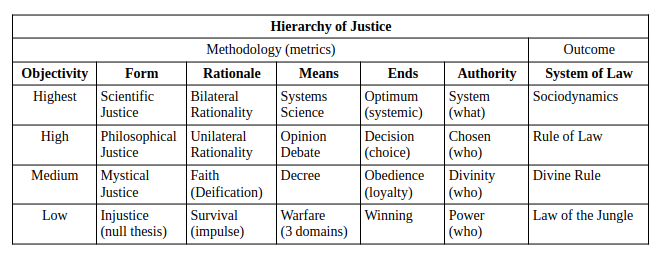
All Systems of Law (Rules) rely on some rationale of Justice as their
foundational basis, whether explicit or implicit. Justice itself, and
the systems of law derived from it, have evolved over the centuries.
These dynamics and structures produce a unified “Hierarchy of Justice”.
The “Star of Justice” is a useful model that integrates the 5 underlying
social principles, as well as the 1 existential principle of
“Randomness” (Fate, Luck, etc.). Constructing a universal System of Law
is therefore contingent upon utilizing the most objective (scientific)
rationale for the principles of Justice.
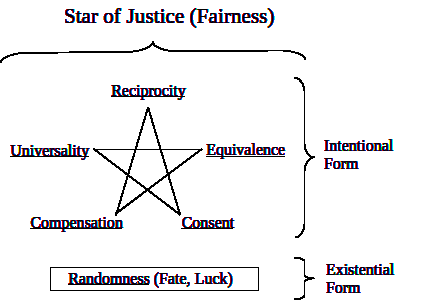
All of the elements of Jusice are interdependent.
Universality
Universality: this simple principle indicates that Justice pertains to all Players equally, at all times. Any exceptions (applied to self or others) directly violate this principle. All theories of action based on “identity” also directly violate this principle. They are therefore illegitimate actions for an optimal political system. Identity Politics, Prejudicial (non-equal) Discrimination, and Selective Enforcement (Tolerance) are common examples of direct violations because they’re all antithetical to the meaning of Universality. Note: “separate is inherently unequal” is a logical fallacy often inadvertently encoded into Law, which often directly violates Individual Freedoms (human rights).
Conflict Resolution
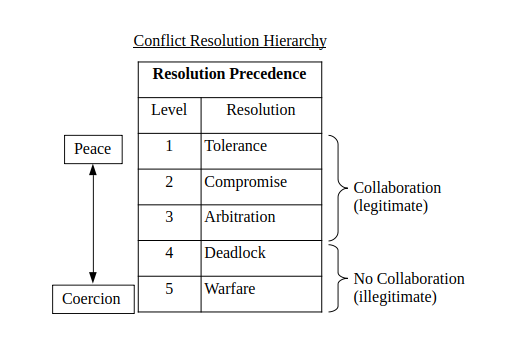
All conflicts between Players (including Warfare) are ideally resolved through a resolution hierarchy. A full attempt by the parties involved must be exhausted at the top level (tolerance), and only then proceeding to the next lower level if that fails, and so on. Only the top 3 levels of resolution can secure optimal outcomes. Avoidance (level 0) of zero sum games, to the fullest extent possible, is the top priority for preventing conflicts from spontaneously arising.
Rule Management
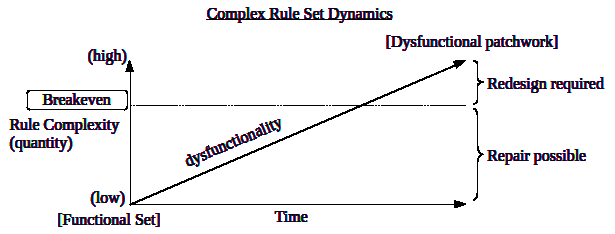
Many systems focus on the creation of rules/laws, but are very weak on implementing processes to keep them up to date. Rule management provides a complete approach to maintenance.
Discussion