
Universal Principles of Justice
These are the universal principles of justice that provide an empirical, scientific basis for all rules/laws intended to produce an optimized human system. They are primarily derived from the social structures and dynamics codified by Agent Archetypes, and Laws of Sociodynamics.
All Systems of Law (Rules) rely on some rationale of Justice as their
foundational basis, whether explicit or implicit. Justice itself, and
the systems of law derived from it, have evolved over the centuries.
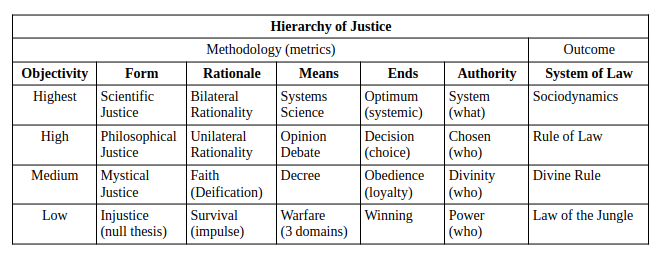
These evolutionary changes can be classified to produce a unified “Hierarchy of Justice”.
Hierarchy of Justice
Star of Justice
The “Star of Justice” is a useful model that integrates the five underlying
social principles, as well as the one existential principle of
“Randomness” (Fate, Luck, etc.). Constructing a universal System of Law
is therefore contingent upon utilizing the most objective (scientific)
rationale for determining the principles of Justice.
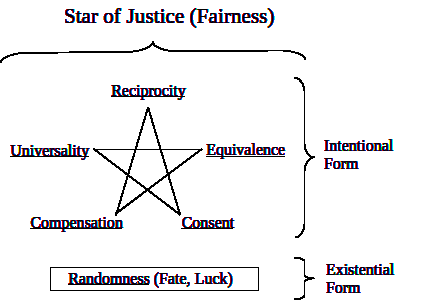
All of the elements in the Star of Jusice are interdependent. Each of the relevant principles are described in detail.
Reciprocity
Universality
Equivalence
Compensation
Consent
Randomness
Conflict Resolution
Due to the universal nature of zero sum games, conflicts can easily arise and they require objective guidance to resolve them with optimum outcomes.
Rule Management
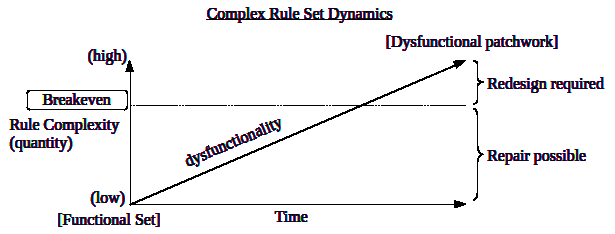
Many systems focus on the creation of new rules/laws, but are weak on implementing processes to keep them up to date. Rule management provides a useful strategy for maintenance.
Discussion