
This is an old revision of the document!
Governance
Freedom of Assembly naturally produces associations of people through commonality. The level of social bonding (affinity) determines communal system integrity and sustainability.
The purpose of a legitimate governance system is to successfully manage the optimum balance between providing Security/Safety while protecting Individual Freedoms. [Security/Freedom dichotomy].
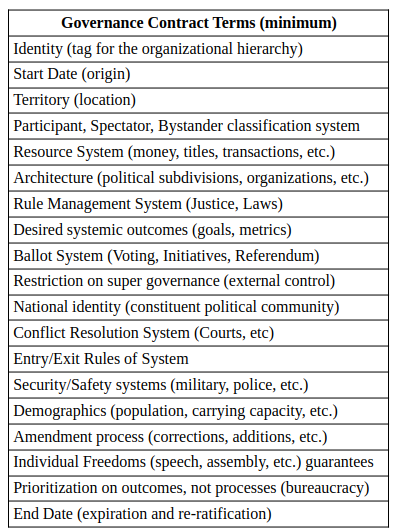
A consequential strategy is necessary for a sustainable community (communal system) that supports the governance system.. The 8 essential affinities [and respective context] that determine social bonding in a community (political) are:
Common Language [interpersonal communications] Common Code of Justice [rules] Common Territory [proximity] Common Genetic Lineage [evolutionary trajectory] Common Welfare (Quality of Life) [sustainability] Common Culture (Beliefs and Behaviors) [limits] Common Family Orientation [natural unit] Common Loyalty (Commitment) [communal preservation]
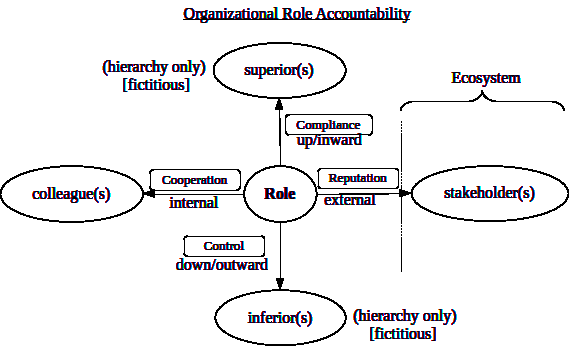
A modern, self-sufficient “Nation” requires a political community of more than 200,000 natural families (800,000 people). A legitimate governance system (government) is a fictitious entity created through a Contract (formal or informal) among and between the members of a Nation. Governments and corporate organizations are fictitious entities (Players) imagined into existence through Contract among real entities (humans). All governance organizations establish hierarchical internal roles with each specific authority and accountability relationship embedded within the structure.
Discussion