This is an old revision of the document!
Universal Agent Archetypes (UAA)
All human systems involve Autonomous Agents (Players, Actors, Entities), both real (people) and fictitious (organizations).
Reflection, is the natural human ability to think and feel about how one thinks and feels. Self-deception and self-awareness are the inversely related internal manifestations of Reflection. Externally, one can therefore also think and feel about how others think and feel (empathy, projection, etc.). This ability becomes fully developed at around 12 years of age (normal). All human adults (Agents) can therefore be classified by this intrinsically “bilateral” mechanism into 4 distinct strategy Archetypes.
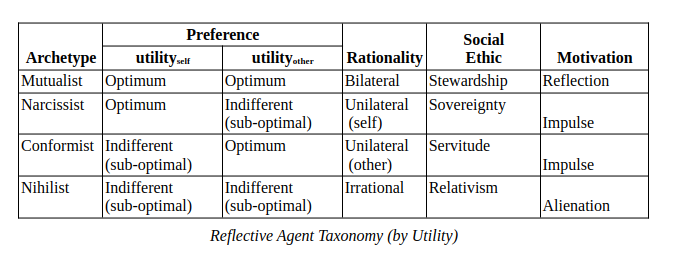
The utility function (goal) in this taxonomy can be defined by narrative and by formal Mechanism Design Theory (MDT). Mutualist Utility Function (narrative form): Optimum of total aggregate utility with a simultaneously optimum of equality (parity) of individual utility. Mutualist Utility Function (MDT 2 x 2 ordinal form): u=((xi + yi) + \|xi </sub>– y<sub>i\|)/2 : where xi </sub>= Agent R utility ordinal (Narcissistic) and y<sub>i = Agent C utility ordinal (Narcissistic).
A complete analysis reveals that only a 100% homogeneous population of Mutualists can consistently produce and sustain optimal social systems as the natural outcome. All other populations can only produce unstable, sub-optimal systems. Since fictitious Agents (States, corporations, etc.) are analogs (legal fictions) of actual humans, their strategic Agency is also fully defined by this same taxonomy.
Ideally, an optimal political system achieves the 4 goals intended for Quality of Life. All Agents that aren’t true Mutualists would be required to consent to acting “as if” they are Mutualists, in order to ensure efficient optimization. Ideally, human systems allow only true Mutualists in control (Leadership) roles within the 3 domains of Social Power, because their behavior would then naturally serve Justice over Power.
There are subconscious motivations as well as conscious motivations for human agents. It’s possible for any Archetype to eventually become a true Mutualists through the practice of self-discipline. The 4 Archetypes, The Substrate, the 3 Impulses, and Reflection constitute the internal framework (first order) that determines systemic outcomes [What is internal is externalized, and what is external is internalized].
Discussion